
Hiring for Leadership Potential vs Proven Experience

When a senior manager or clinical lead leaves your healthcare organisation, the natural impulse is to replace them with someone who has done the exact same job for years. Hiring managers look at a CV, tick off the historical checkboxes and assume past performance guarantees future success.


Outside the hospital system, in primary care, aged care, NGOs and private medical clinics, this approach is hitting a wall. The New Zealand healthcare environment is shifting rapidly. Relying solely on historical experience can lock out adaptable, high potential professionals who possess the exact emotional intelligence and agility required to lead modern teams.

Market Realities: The Leadership Landscape

  • The Retention Connection: Leaders selected for emotional intelligence and communication potential achieve up to 30 percent higher team retention rates.
  • The Talent Pool Shortage: Waiting for a candidate with identical niche experience extends vacancy timelines by an average of forty-five days.
  • Adaptability Dividend: Health professionals hired for potential master new digital systems and regulatory updates twice as fast as rigid industry veterans.

Quiz: Evaluate Your Hiring Mindset

Answer these four questions to see if your recruitment framework values future potential or just historical tenure:

  1. Do you reject established professionals simply because they come from a different healthcare category outside the hospital system?
  2. Are your interview questions focused more on past technical tasks than on how a candidate mentors junior staff?
  3. Can your organization identify internal clinicians who display leadership traits but lack formal management titles?
  4. Do you value problem solving agility and strategic empathy as heavily as years spent on a roster?


Your Scorecard:

3 to 4 Yes answers: Future focused. You are built to secure resilient, long-term talent.


0 to 2 Yes answers: History locked. Your vacancy timelines are likely exposed to market talent shortages.


How to Screen for Leadership Potential

Shifting your onboarding framework from past history to future trajectory requires a clear methodology. Follow these three steps during your next hiring loop:


First, introduce behavioral scenario testing. Present the candidate with a realistic team conflict, a sudden roster crisis or a clinical communication breakdown. Analyze their structural problem solving pathway rather than checking if they have faced that exact scenario before.


Second, measure psychological safety and empathy. Ask candidates how they support frontline workers through clinical stress and burnout.


Finally, value transferable excellence. Look at how an allied health leader or an NGO operations coordinator can bring fresh, valuable viewpoints into your primary care or aged care network. Potential is about what a professional can deliver tomorrow, not just what they completed yesterday.

Secure Your Next Permanent Team Leader

Finding high potential leaders for community, primary and private health takes deep sector expertise. At RWR Health, we operate exclusively in the New Zealand health market outside the hospital network. We know your language and we know how to identify the talent that will help your business thrive.

Contact the RWR Health team today to get expert recruitment support in securing your next permanent leader.
By RWR Group Marketing August 17, 2026
Learn how general practitioners, practice nurses and practice managers can navigate career progression outside the NZ hospital system.
By RWR Group Marketing August 10, 2026
Discover why leadership roles outside the hospital system are rising and how to prepare for your next permanent healthcare career step in NZ.
By RWR Group Marketing August 3, 2026
Discover how a permanent talent strategy resolves hiring challenges in NZ primary care, aged care, and community health organizations.
By RWR Group Marketing July 28, 2026
Discover practical strategies to retain your best healthcare professionals.
By RWR Group Marketing July 20, 2026
Understand what NZ health employers are looking for in mid-senior hires. Practical insight for experienced health professionals.
By RWR Group Marketing July 14, 2026
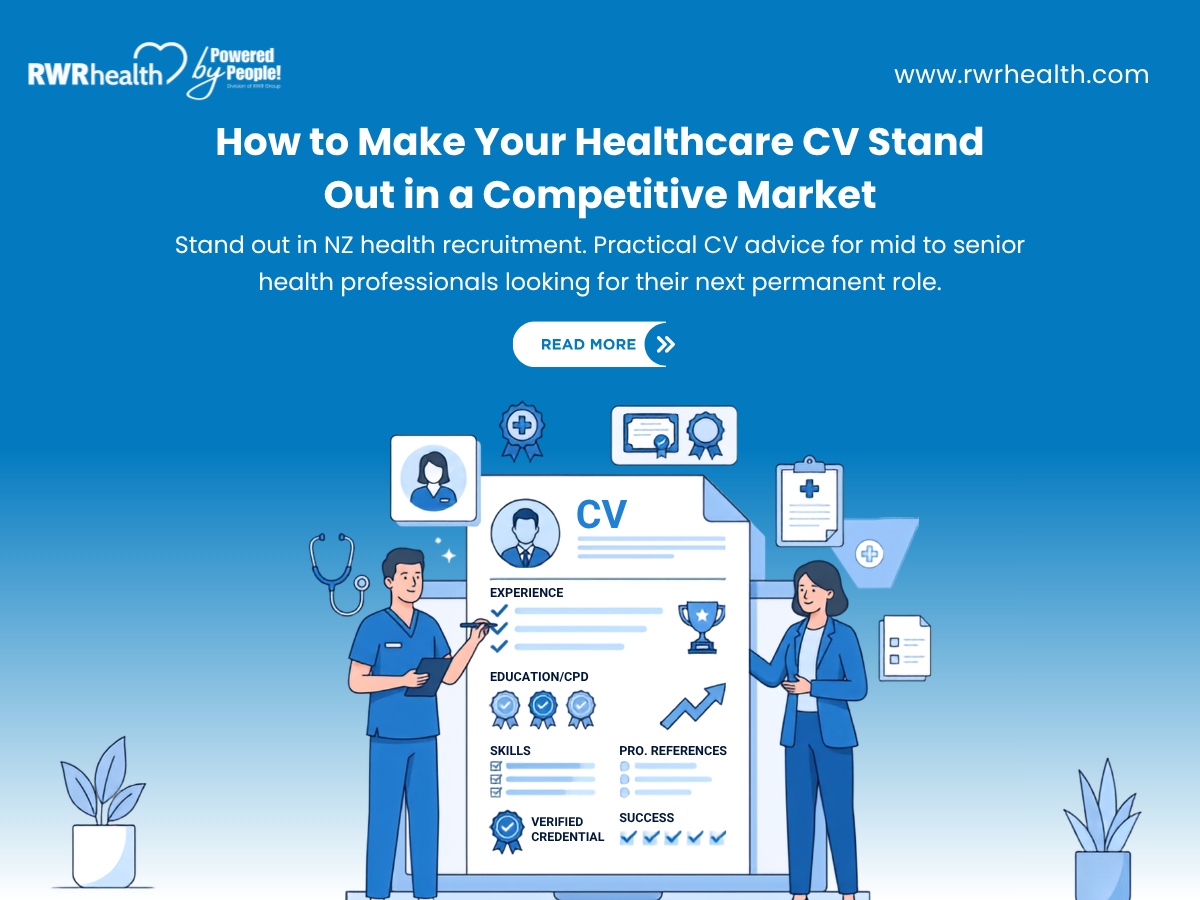
Stand out in NZ health recruitment. Practical CV advice for mid to senior health professionals looking for their next permanent role.
By RWR Group Marketing July 6, 2026
Salary gets people in the door. Culture is what keeps them there. Across New Zealand's health sector, we are seeing the same pattern repeat: organisations lose their best senior people not always to better pay, but to better workplaces. The professional has found somewhere that feels right. And that feeling is built on culture. What Professionals Are Looking For After years of experience, health professionals know what they want from a workplace. They are not easily impressed by perks or job titles. What they respond to is depth: clear values, consistent leadership, psychological safety and a sense that the organisation genuinely cares about the people delivering care. In our conversations with experienced GPs, allied health clinicians, practice managers and aged care leaders, a few themes come up consistently. WHAT CULTURE MEANS TO HEALTH PROFESSIONALS Leadership that listens and follows through A team that supports each other, especially under pressure Recognition that goes beyond performance reviews Genuine flexibility, not just a policy on paper A workplace where raising concerns is safe and welcomed Culture Is Not a HR Initiative One of the most common mistakes health employers make is treating culture as something the HR team manages. In reality, culture is built and broken in everyday interactions. How a person is briefed before a difficult conversation. Whether a practice manager is consulted before a process change. How a team responds when someone admits they are stretched. Leaders at every level carry culture. And senior professionals are watching closely. What This Means for Retention When a high-performing person hands in their notice, it is rarely a sudden decision. It is the end of a longer journey that often started with a moment of disconnection. A decision made without their input. A value that was stated but not lived. A leader who did not follow through. The organisations retaining their people are the ones paying attention to these moments. They are conducting stay conversations, not just exit interviews. They are creating conditions where people feel seen before they start looking elsewhere. Start the Conversation If you lead a health organisation and you are not actively talking to your people about what they need, now is the time to start. Not just about pay. About how the work feels. About what would make them stay for another three years, not just another quarter. At RWR Health, we work with health employers across New Zealand to attract and retain permanent staff across primary care, aged care, allied health, NGO and private medical sectors. Visit www.rwrhealth.co.nz to find out how we can help, or get in touch to have a confidential conversation about your team.
By RWR Group Marketing June 10, 2026
By RWR Marketing
By RWR Group Marketing May 19, 2026
Real long-term outcomes from healthcare professionals who migrated to Australia and New Zealand. Where are they now and what would they tell you?
By RWR Group Marketing May 14, 2026
Worried AI will replace your healthcare role? Here's what's actually changing, what isn't and why the sector remains one of the most secure career paths.