
Being Busy Is BS and Just Another Form of Hiding

Let’s call it.

Most people aren’t productive, they’re just panicking in a suit.

They’re chasing their tails in a tornado of meetings, emails, Slack pings, task boards, and "quick calls" that go nowhere. And when you ask them how they’re going?


“Oh mate, flat out.”

Yeah. Flat out… doing what?

Because here’s the thing: being busy is easy. Being effective is rare.


Busy people do a lot. Effective people get results.


There’s a big difference, and most professionals have lost sight of it.


Somewhere along the way, output got replaced with activity. Effort replaced outcomes. Time spent became more important than value delivered.

And let’s be honest: a lot of people are buying their own bullshit. They're mistaking motion for progress. Praise themselves for being 'slammed’ when all they're really doing is sweating through chaos they created by saying yes to everything and finishing nothing.


This isn’t just a recruitment problem. This is an everywhere problem.


Recruiters sending 100 cold reach-outs a day but filling nothing.

Managers drowning in back-to-back calls with no strategy behind them.

Leaders caught in decks, dashboards and “quick check-ins” that don't move a single KPI.

Whole teams doing cartwheels just to look productive.


The worst part? Everyone knows it. But no one wants to say it.


So let me:
If your calendar is full and your scoreboard is empty, you’re not busy. You’re stuck.


Busy is a drug. And it’s addictive.


It makes you feel needed. Important. In demand. It fills the awkward silence where results should be.


But it’s also the perfect cover for lack of clarity, fear of failure, and decision avoidance. You can’t be held accountable if you’re “so busy.” You can’t be questioned if you’re burning the candle at both ends.

And we reward it.


We praise the hustle. We applaud the exhaustion. We promote the performers who work late… even if they never win.

Meanwhile the people who quietly deliver results, they get overlooked, because they’re not seen to be grinding.

Insanity.


High-performers don’t look busy. They look calm.


They say “no” more than they say “yes”.

They don’t join every meeting.
They don’t reply to emails instantly.
They’re not in Slack all day.


Because they’re busy thinking, doing, and delivering. They know the only KPI that matters is impact. Not noise. Not motion. Not airtime.

If you don’t know what that looks like, chances are you’re surrounded by performers, not producers.


So what now?

Ask yourself:

  • What did I do today that actually mattered?
  • If I stopped half my tasks, would anyone notice?
  • Am I producing outcomes, or just managing perception?


It’s not comfortable. But that’s the point.

You don’t fix a culture of noise by adding more updates.

You fix it by measuring results, not reputations.

You fix it by rewarding effectiveness, not effort.

You fix it by cutting the crap and getting clear on what success actually looks like.


So, are you actually making a dent? Or just looking busy?

I’d love to hear your take.
Drop a comment, disagree, tag someone who needs this.


Let’s talk about it.


By RWR Group Marketing • September 20, 2026
Some healthcare teams turn over constantly. Others barely lose a permanent staff member year after year. The difference usually isn't the pay. It's the leader. We work closely with employers across primary care, aged care, allied health and community services, and the pattern is consistent: thriving teams share a leader with the same handful of habits. None of them is complicated. All of them take consistency. They communicate before problems become crises Strong leaders don't wait for a formal review to raise an issue or share praise. They check in regularly, in person, briefly and often. Staff know where they stand because their leader tells them, not because they have to guess. They make it safe to speak up Teams thrive when people can flag a mistake, question a process or push back on a decision without fear. Leaders who build this kind of psychological safety hear about small problems early, before they become resignations. They delegate real responsibility, not just tasks Handing someone a task is management. Handing someone genuine ownership of an outcome, and backing their decisions, is leadership. Staff who are trusted with real responsibility are far more likely to stay in a permanent role long term. They recognise contribution specifically "Great job team" doesn't land the way specific recognition does. Naming exactly what someone did well, and why it mattered, tells staff their work is actually being noticed, not just acknowledged in passing. They protect their team's time and wellbeing Thriving teams have leaders who push back on unreasonable demands from above, protect rosters from constant last-minute changes, and model healthy boundaries themselves. Staff notice when a leader has their back. They coach instead of just correcting When something goes wrong, strong leaders ask questions before giving answers. "What do you think happened here, and what would you do differently?" builds capability. Simply telling someone what to do next time doesn't. Key Takeaways Regular, informal check-ins build more trust than annual reviews ever will. Psychological safety is what surfaces small problems before they become big ones. Real delegation, not just task handoff, is what keeps senior staff engaged. Specific recognition beats generic praise every time. Protecting your team's time is a leadership act, not a nice-to-have. Coaching builds capability; correcting just fixes the moment. If your team's turnover has been creeping up, it's worth looking at leadership habits before you look at pay. The organisations that keep their best permanent staff usually aren't paying the most. They're led the best. Want to build a leadership approach that keeps your best people? Visit www.rwrhealth.co.nz/contact-us to talk about your team.
By RWR Group Marketing • September 16, 2026
You didn't reach a leadership level in primary care, aged care, or allied health by accident. So when you're weighing up a new permanent role, you're not just checking the salary. You're reading between the lines. Here's what experienced clinical leaders look for before they say yes, plus a few quiet red flags to watch for early. Autonomy that's real, not just talked about Leaders want to know they'll be trusted to make clinical and operational decisions, not just carry the title while someone else calls the shots. In interviews, ask directly: "What decisions would sit with me, and what would need sign-off?" The answer tells you about how the organisation operates. A team that's ready for leadership, not just a vacancy A leadership role is only as good as the team underneath it. Before accepting, find out why the position is open. A newly created role to support growth feels very different to a role that's turned over three times in two years. Support from above, not just responsibility from below The best permanent leadership roles come with a manager or director who backs you, resources you and removes obstacles. Ask who you'll report to and how often. If nobody can give you a clear answer, that's worth noting. Room to actually lead, not just manage rosters Clinical leaders want to shape how care is delivered, mentor junior staff and influence policy, not fill gaps in a schedule. Look for organisations that talk about your input on clinical governance, service design or team development, not just your availability. Values alignment you can test Anyone can describe a values-driven organisation in an interview. Ask for a specific, recent example: a decision the leadership team made that reflected those values under pressure. If they can't give you one, that's a signal. Quick Quiz: Are You Ready for Your Next Leadership Role? Can you clearly describe the kind of team culture you want to build? Do you know the three non-negotiables you need from an employer before you'll say yes? Have you asked a potential employer why the role became available? Do you feel confident naming what "support from leadership" should actually look like day to day? Are you clear on the difference between a role you'd tolerate and one you'd thrive in? If you answered yes to four or five, you're in a strong position to negotiate on your terms. If it's closer to two or three, it might be worth clarifying your non-negotiables before your next conversation. Considering your next permanent leadership move in primary care, aged care, allied health or community services? Visit www.rwrhealth.co.nz/contact-us and let's talk about roles that actually match what you're looking for.
By RWR Group Marketing • September 15, 2026
The best clinicians in primary care, aged care and allied health are rarely short of options. So when a permanent role lands on their desk, the real question isn't "will they apply?" It's "why would they choose you over the practice down the road?" After years placing permanent talent across primary care, aged care, allied health, NGOs, private medical and community services, we've noticed the standout employers all do a handful of things differently. None of it is complicated. Most of it costs nothing but attention. Your reputation arrives before you do Candidates talk. Former staff talk. Long before someone applies for a permanent role, they've usually asked around or checked reviews. Standout employers treat their reputation as something to actively manage, not something that just happens to them. Culture that's visible, not claimed Every organisation says it has a "supportive team" and a "great culture." Standout employers show it. That might mean a clear induction plan, a manager who actually checks in during the first month, or rosters that reflect real respect for work-life balance. Candidates can tell the difference between a slogan and a lived experience within weeks of starting. Growth pathways that are mapped out Experienced healthcare professionals want to know what's next, not in five years, but in twelve months. Standout employers can describe a genuine progression pathway on the spot: extra clinical responsibility, a team lead track, funded professional development. Vague promises don't cut it anymore. Flexibility with real boundaries Flexibility doesn't mean "anything goes." It means being upfront about what's negotiable (start times, part-time options, hybrid admin work) and what isn't. Candidates for permanent roles are comparing your flexibility against every other offer they're weighing up, so clarity wins over vague generosity. Values show up in the small decisions Anyone can put "person-centred care" on a careers page. Standout employers can point to a decision they made last month that proves it: a roster change to protect a staff member's wellbeing, a client complaint handled with the team's input, a policy that reflects the mission statement. That consistency is what makes people stay. Is Your Organisation a Standout Employer? Quick Checklist ☐ Can a candidate find genuine, recent reviews from your current or former staff? ☐ Does your onboarding plan go beyond the first day? ☐ Can you name a real progression pathway for this exact role? ☐ Have you clearly defined what flexibility looks like, in writing? ☐ Can you give one recent example of your values shaping a real decision? If you ticked three or fewer, that's not a failure, it's a starting point. The organisations that win permanent healthcare talent aren't perfect. They're just honest about where they stand and deliberate about closing the gap. Ready to build an employer brand that experienced healthcare professionals actually want to join? Visit www.rwrhealth.co.nz/contact-us and let's talk about your next permanent hire.
By RWR Group Marketing • August 24, 2026
Learn why evaluating leadership potential over basic experience secures better permanent talent for NZ community and private health providers.
By RWR Group Marketing • August 17, 2026
Learn how general practitioners, practice nurses and practice managers can navigate career progression outside the NZ hospital system.
By RWR Group Marketing • August 10, 2026
Discover why leadership roles outside the hospital system are rising and how to prepare for your next permanent healthcare career step in NZ.
By RWR Group Marketing • August 3, 2026
Discover how a permanent talent strategy resolves hiring challenges in NZ primary care, aged care, and community health organizations.
By RWR Group Marketing • July 28, 2026
Discover practical strategies to retain your best healthcare professionals.
By RWR Group Marketing • July 20, 2026
Understand what NZ health employers are looking for in mid-senior hires. Practical insight for experienced health professionals.
By RWR Group Marketing • July 14, 2026
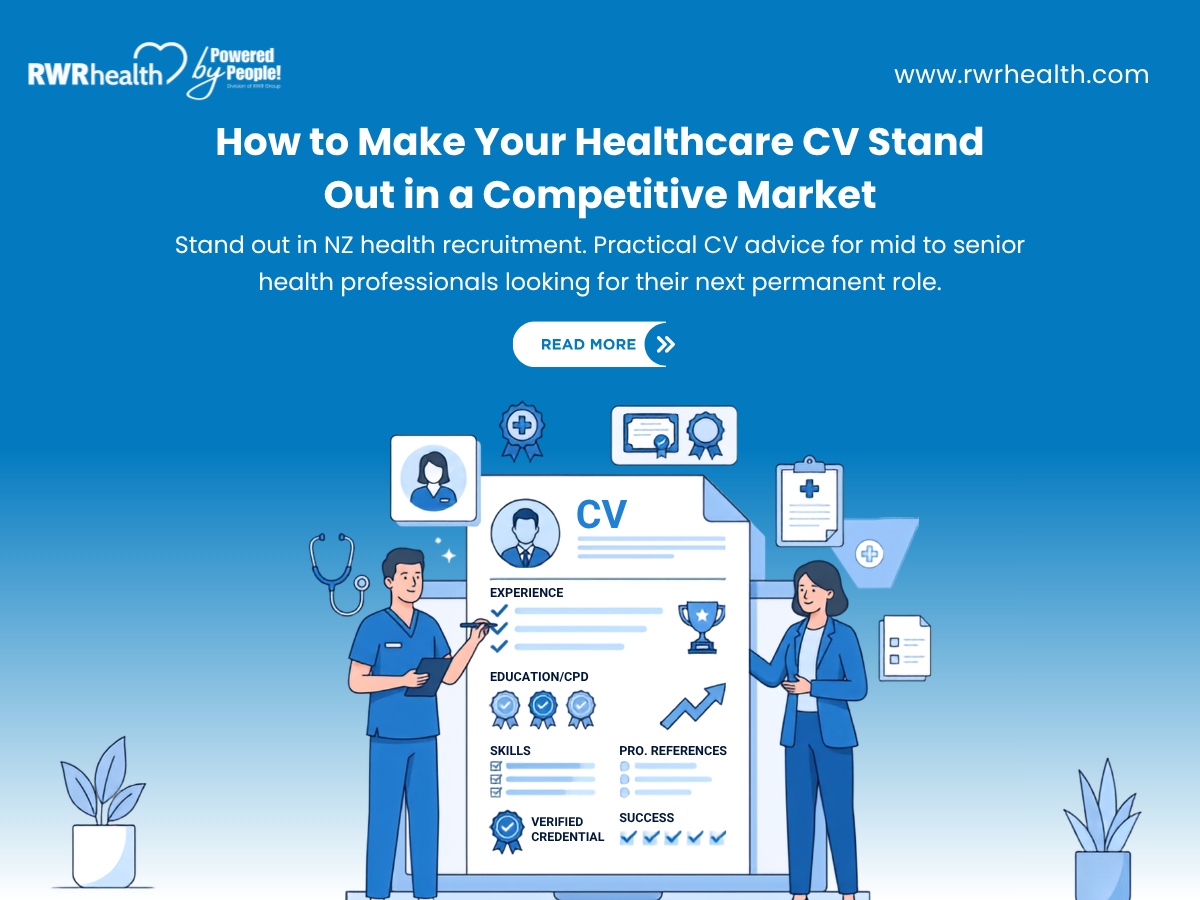
Stand out in NZ health recruitment. Practical CV advice for mid to senior health professionals looking for their next permanent role.